

6 Best Dirt Bike Street Tires in 2026 – Gear Sustain
This post may contain affiliate links. That means if you click and buy, we may receive a small commission (at zero cost to you). Please see our full disclosure policy for details.

Running a dirt bike street tires is one of the most satisfying upgrades you can make, and one of the easiest to get wrong. Get it right and a dirt bike with street tires is a light, flickable machine that is genuinely fun on tarmac, and easy to live with. Get it wrong and you have ordered rubber that will not mount on your wheels, which is an expensive place to end up.
That last point is where most guides fall down, including the previous version of this one. Before you order anything for a dirt bike with street tires, take account of one number: your rim diameter. A dirt bike rolls on a 21-inch front and an 18-inch rear. Almost every tire marketed as a “street tire” is built for a 17-inch road wheel and cannot be fitted to a dirt bike at all. We have rebuilt this guide around rubber that actually fits.
There are exactly two ways to do this properly, and which you choose changes everything about the bike. You can keep your stock wheels and fit DOT-approved dual-sport rubber, or you can convert to 17-inch supermoto wheels and run proper sport rubber. The first keeps your off-road ability and costs the least. The second transforms road handling and effectively ends serious trail use.
Below are six options covering both routes, all verified as available and all in sizes that will fit. Read the owner review threads on the enthusiast sites too, because real-world mileage on a dirt bike with street tires varies more than any spec sheet suggests. We have also added a street-legal checklist, because tires are only one item on the list.
The Two Bike Routes, and How to Choose
Keep your stock wheels. Fit DOT-approved dual-sport rubber in 21-inch front and 18-inch rear sizes. You keep the bike’s off-road ability, you spend the least, and swapping back is simple. The compromise is that even the most road-biased dual-sport tire gives up grip and braking distance to a proper road tire. This is the right route for most people.
Convert to supermoto. Fit a 17-inch wheel set front and rear, then run sport rubber. The transformation is dramatic: huge grip, real lean angle, and brakes that finally have something to work against. Budget for the wheels on top of the rubber, and accept that the bike is no longer much use off-road.
The deciding question is easy enough. If you still want to ride trails and just need to link them on tarmac, stay on your stock wheels. If the dirt bike has become a road bike, convert it.
1. Shinko 705 — Best Overall for Stock Wheels
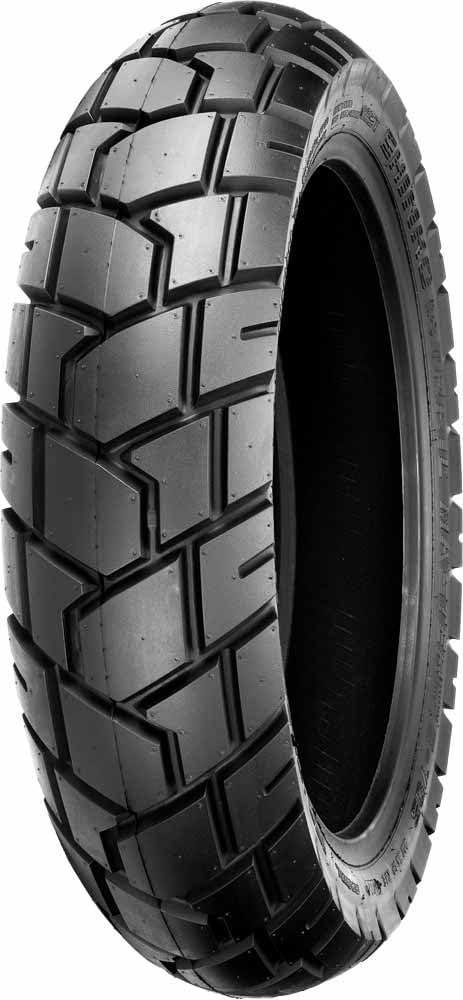
The Shinko 705 is the one we would put most riders on. It is built as an 80% street and 20% trail tire, which is the right balance for a dirt bike that mostly sees pavement, and it comes in 90/90-21 front with 120/80-18 and 150/70-18 options.
The tread is closer to a road pattern than a knobby, with continuous shoulder blocks that provide real contact on tarmac rather than the squirm you get from spaced knobs. It is DOT approved, it is quiet at road speed, and it is among the cheapest things here.
Pros
• Genuine 80/20 street bias
• Available in stock dirt bike sizes
• Quiet and stable on pavement
• Affordable
Cons
• Limited in deep mud or sand
2. Mitas E-07 — The 50/50 All-Rounder
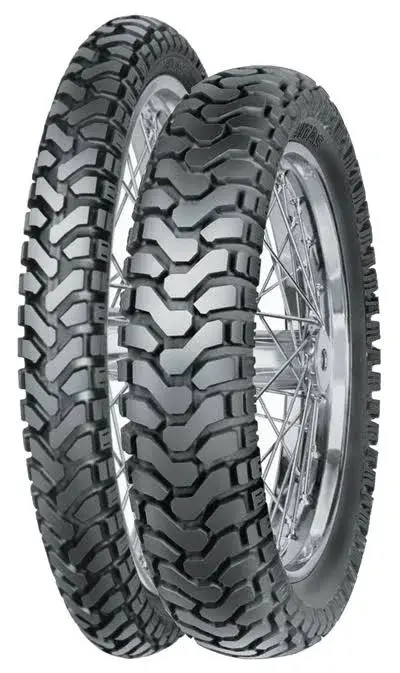
If you split your riding evenly, the Mitas E-07 is the answer. It is a true 50/50 design and has become the default choice for riders who want one set of rubber to handle both surfaces without feeling hopeless at either.
Sizes include 90/90-21 front and 120/80-18 or 140/80-18, and the tubeless bias construction is tougher than it looks. The E-07+ variant shifts the front to roughly 60/40 street if you want to lean further toward the road.
Mileage is the quiet strength here. Riders routinely report it outlasting knobby options by a wide margin, which matters when you are paying for a set twice a season.
Pros
• Honest 50/50 performance
• Long life for a dual-sport tire
• Tubeless bias construction
• Wide size range
Cons
• Noisier than a road-biased tire at speed
3. Pirelli MT 21 Rallycross — DOT Knobby, Dirt-Biased
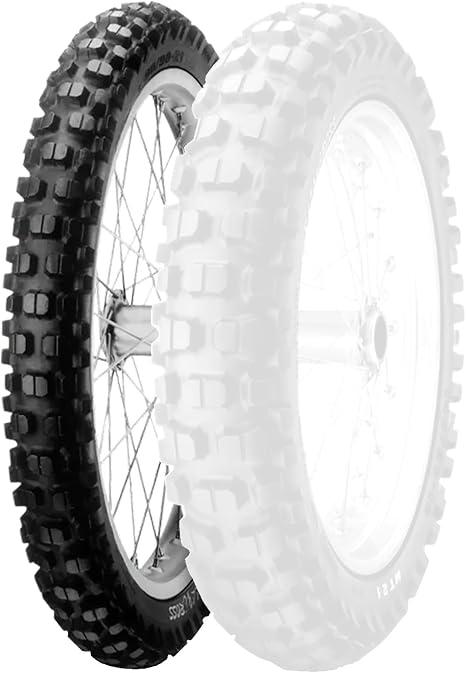
The MT 21 is a 10% road and 90% off-road tire that happens to carry DOT approval. That matters: it lets you ride legally on tarmac between trails without pretending it is a road tire.
It comes in 80/90-21 and 90/90-21 front and 120/80-18 and 140/80-18, and prices run from about $120 to $164 a tire. The blocky tread is what gives it off-road bite, and it is also what makes it squirm under hard braking on pavement.
Choose this if your riding is mostly dirt with road sections in between. Do not choose it if you are commuting.
Pros
• Excellent off-road grip
• DOT approved for road sections
• Broad size range
Cons
• Poor braking and cornering on tarmac
• Wears quickly if ridden mostly on road
4. Dunlop D606 — The Hard-Wearing DOT Knobby
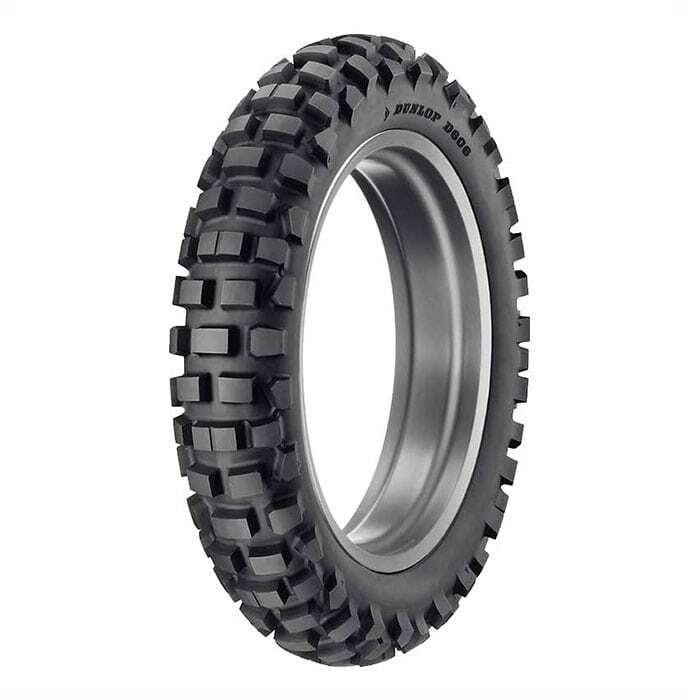
The D606 is the best known DOT knobby, and with good reason. It is a 90% off-road design in 90/90-21 front and 120/90-18, with a stiff carcass and deep blocks that survive abuse far better than most.
At $150 to $199 a tire it is the most expensive of the stock-wheel options, and the payoff is durability rather than road manners. On pavement it is noisy, it tramlines, and it needs respect in the wet.
Think of it as a dirt tire you are permitted to ride home on, not a street tire.
Pros
• Very durable carcass
• Strong off-road traction
• DOT approved
Cons
• Expensive
• Noisy and vague on pavement
5. Continental ContiAttack SM 2 — Best Supermoto Tire
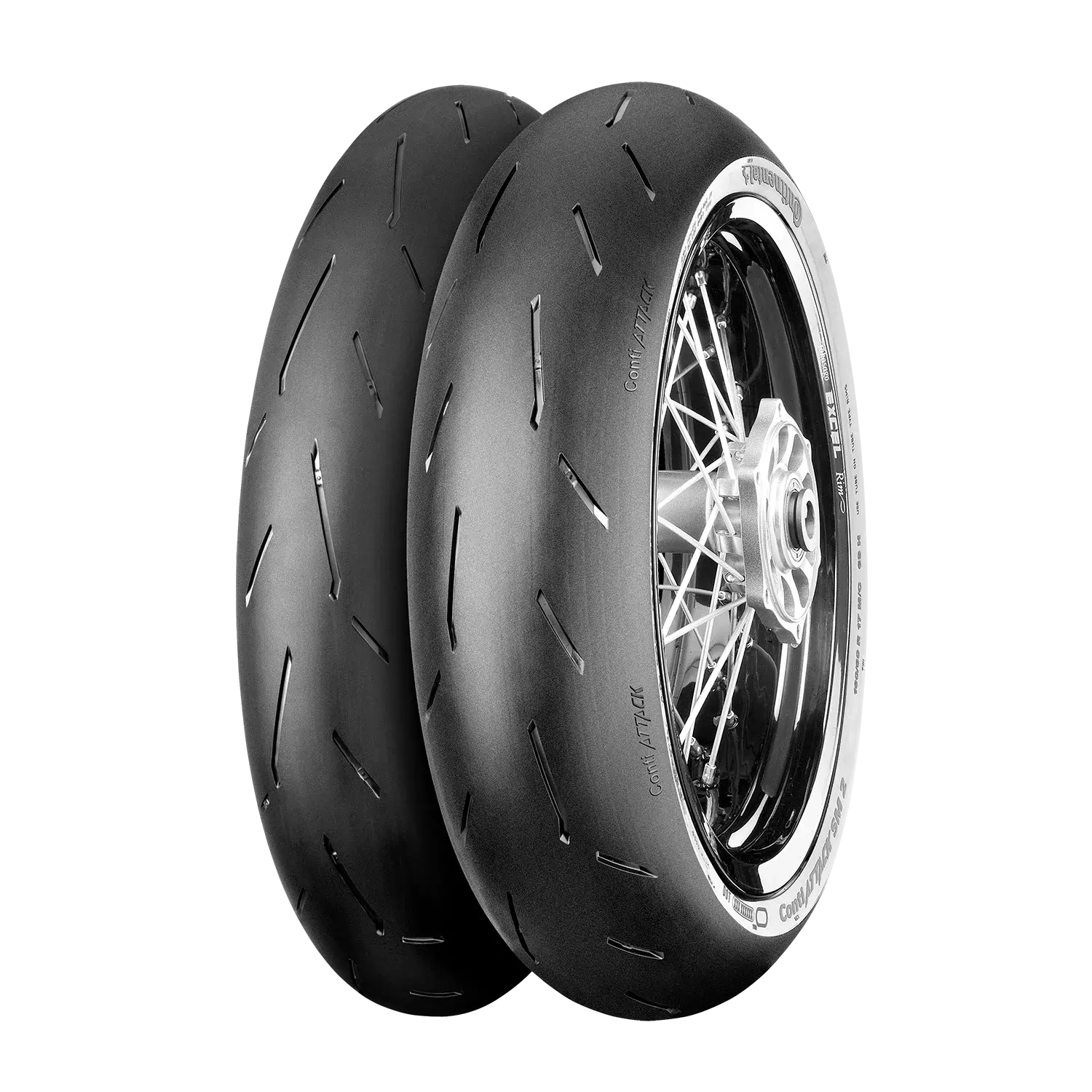
If you have converted to 17-inch wheels, this is the tire to buy. The ContiAttack SM 2 is purpose-built for supermoto rather than borrowed from a sportbike, and it is widely regarded as the benchmark for street use.
Sizes run 110/70R17 and 120/70R17 at the front with 140/70R17, 150/60R17 and 160/60R17 behind, which covers essentially every conversion. A full set runs $407 to $430. Continental describes it as track-proven and street legal, and that is a fair summary: it warms up fast, which is what a light bike on short road rides needs.
Check your rim width before ordering. A 4.25-inch rim generally takes a 150/60-17, while a 5.0-inch rim suits a 160/60-17.
Pros
• Purpose-designed for supermoto
• Warms up quickly on short rides
• Full range of conversion sizes
• Equally at home on track
Cons
• Sold at a premium
• Useless off-road
6. Pirelli Diablo Rosso IV — The Sport Alternative

If you want more outright grip and less of a supermoto-specific design, the Diablo Rosso IV is the sport tire most converted bikes end up on. It is available in 120/70-17 front and 150/60-17 or 160/60-17 behind, at roughly $150 to $199 a tire.
This is a hypersport pattern, so dry grip and turn-in are superb and the profile is sharper than the Continental’s. The trade is warm-up time: on a light bike doing short trips it takes longer to come up to temperature than the ContiAttack does.
Pros
• Outstanding dry grip
• Sharp, quick turn-in
• Wide availability
Cons
• Slower to warm up on short rides
Shorter life if ridden hard
Choosing the right street tires for your dirt bike
When buying street tires for your dirt bike, it’s important to learn about:
Reliable in different road conditions
This is the first thing to learn about road rubber: all-season reliability matters. Whether the road is wet, dry or cold, the bike should feel predictable. At higher speeds a road-biased tire offers far more stability than a knobby, because its continuous tread provides a larger contact patch that does not deform under load. Look for rubber that holds its performance in adverse weather rather than only when warm and dry.
Handling
Street rubber should respond cleanly to braking, cornering and acceleration. This is the clearest difference between the two routes: a knobby pattern squirms because each block flexes independently, which lengthens braking distances and makes the front feel vague. A supermoto tire eliminates that entirely.
Performance
Pay attention to compound as well as pattern. Higher silica content improves wet grip and cold performance, which is why modern road rubber works so much better on a cool morning than older designs did. Dual-compound construction, where a harder centre resists wear and softer shoulders provide grip, is common on the road-biased options here and worth having.
Price
You can get a decent set of dual-sport rubber for around $200 to $300 for the pair, and a supermoto set will run $300 to $450 depending on your choice. Cheaper rubber generally lasts a shorter time, so the running cost evens out more than the sticker price suggests.
One item the previous guide left out: if you are going the supermoto route, budget for the wheels too. A complete 17-inch wheel set is a significant cost on top of the rubber, and fitting services at a shop will add to it.
Frequently asked questions
How do you know it is time to replace your tires?
Replace when the tread reaches the wear bars, which mark the 2/32-inch legal limit, or when you see cracking in the sidewall or tread grooves.
Age matters separately from wear. Our previous version said to bin tires at five years, which is not quite right. Michelin’s guidance is to have them professionally inspected every year once they pass five years, and to replace them at ten years regardless of remaining tread. Find the DOT code on the sidewall: the last four digits give the week and year of manufacture, so 1924 means week 19 of 2024.
How should you choose by terrain?
Soft terrain rubber is for loose material such as sand and mud, with tall widely spaced knobs. Hard terrain rubber uses tightly packed small knobs for rock and hardpack. Intermediate designs sit between the two. For road use, none of these are what you want — go for the 80/20 or 50/50 options above, or convert to 17-inch wheels.
How do I make my dirt bike’s street tires last?
Pressure is most of it. Run the pressure on your bike’s placard for road use, typically somewhere near 28 to 32 psi for a dual-sport tire on pavement, and drop it for dirt. Running low pressure on the road builds heat and destroys a tire quickly; running dirt pressures on tarmac is the single most common way people wear out an expensive set in a season.
Keep a gauge in the garage and check before every ride. Heat and UV also age rubber, so store the bike out of direct sun or throw a cover over it.
Final Thoughts
The best choice depends on what you want the bike to be. If it is still a dirt bike that occasionally sees tarmac, the Shinko 705 or Mitas E-07 will serve you well and let you continue riding trails. If it has become a road bike, convert to 17-inch wheels and fit the ContiAttack SM 2 — the difference is not subtle.
Whichever route you take, check the size against your wheels before you order. That one step would have saved the previous version of this guide, and it will save you a return.
If you found this useful, share it with other riders and leave a comment with what you are running. Thanks for taking the time, and we will keep working to improve these guides.
10 Best Dirt Bike Brands You Can Buy


